


Moss Walls vs Acoustic Panels
An honest comparison based on laboratory data only: measured NRC values, absorption classes, fire indices, and what supplier claims often leave out.
Table of contents
#Why this comparison is usually done wrong
Search for "moss walls vs acoustic panels" and you will find confident numbers on both sides: moss absorption figures quoted without a standard, a laboratory, or a mounting configuration, and panel ratings measured with an air gap that the installed product will never have.
The result is a comparison between a marketing claim and a laboratory measurement, which is not a comparison at all.
#How sound absorption is actually measured
Credible absorption values come from reverberation room measurements following recognized standards: ISO 354 for the measurement itself, ISO 11654 for the weighted absorption coefficient and the absorption class (A to E), and ASTM C423 for the NRC and SAA indicators used in North America.
- NRC (Noise Reduction Coefficient): a four-frequency average of absorption, from 0.00 to 1.00.
- Absorption class (ISO 11654): a letter from A (most absorbent) to E, weighted across a frequency curve.
- Mounting matters: the same product can measure very differently direct-mounted versus with an air gap behind it. Always ask which configuration was tested.
The two systems weight frequencies differently, so a Class D product can still carry a high NRC. That is not a contradiction. It is why serious suppliers publish both, with the report.
For reference, ISO 11654 is the international standard for rating the sound absorption of building products from ISO 354 measurements, and ASTM C423 defines the reverberation room method used to calculate NRC and SAA in North America.
#What conventional acoustic panels achieve
Conventional interior acoustic panels, most commonly PET felt made from recycled plastic bottles, are effective absorbers. Advertised values typically range from NRC 0.45 for thin direct-mounted panels up to 0.90 or more for thick panels measured with an air gap behind them.
Both ends of that range are real. The point is that the high numbers usually describe a specific mounting configuration, not the panel glued flat to a wall. If a datasheet quotes NRC 0.95, ask whether that was measured with an E-400 mounting (400 mm air cavity) or direct-mounted. The answer often explains half the number.
Panels win on raw absorption per square meter and on price. What they do not offer is a natural material story: PET felt is plastic, and most spaces that choose it accept that trade-off knowingly.
#What preserved moss walls actually measure
Preserved moss is a genuinely absorbent material: soft, porous, and irregular, which is exactly what mid and high frequencies (the human speech range) respond to. But moss types differ widely, and honest data shows it.
The values below were measured on the material itself in reverberation rooms, per ISO 354 / ISO 11654 and ASTM C423, by two accredited European laboratories: CARE-CEDIA at the University of Liege (Belgium) and Peutz bv (Netherlands). Every report is a public PDF.
Two things are worth noticing. First, Ball Moss at NRC 0.73 sits inside the range of many conventional panels as actually installed, while offering a natural preserved plant surface without a plastic acoustic core. Second, Reindeer Moss measures 0.35. We publish that number anyway, because it is the measured one. Reindeer moss is often the type behind spectacular absorption claims elsewhere, usually quoted without a report.

#What cork acoustic tiles measure
Cork wall tiles are a different acoustic profile: denser, harder, and lower absorption than moss, with the benefit of being a durable, tactile, fully natural surface. Measured on the material per ISO 11654 by Peutz bv:
- Morse: Class D, NRC 0.40
- Sillon: Class D, NRC 0.30
- Parenthese: Class E, NRC 0.20
- Brickx: Class E, NRC 0.20
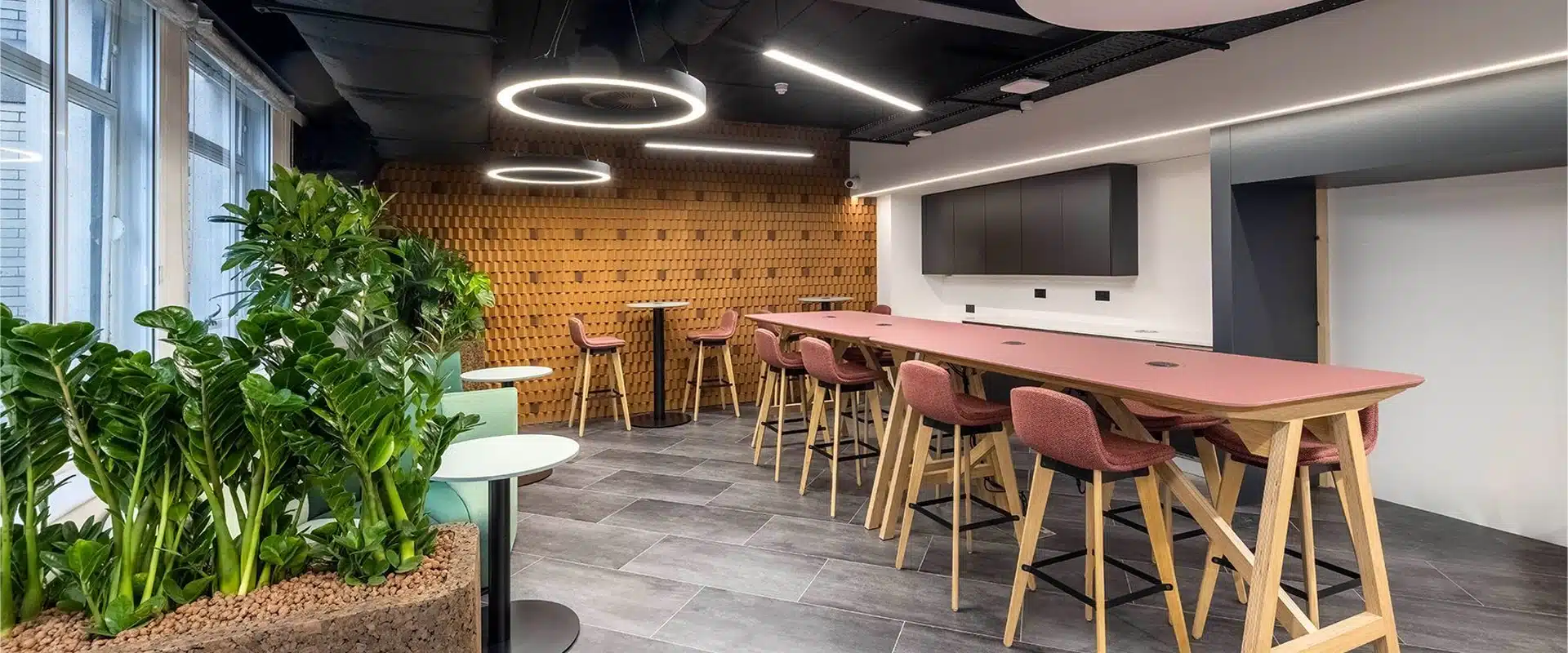
Cork tiles are best specified as a contributing surface within a wider acoustic strategy, not as the primary absorber. Their sculpted geometry also diffuses reflections, which flat panels do not. For tailored configurations, see our custom acoustic cork wall options.
#Red flags in supplier acoustic claims
When you compare moss walls and acoustic panels, discard any number that comes with one of these:
- No standard named. "Absorbs up to 90% of sound" is not ISO 354, ISO 11654, or ASTM C423.
- No laboratory named. Accredited labs put their name on reports. Marketing departments do not.
- No report available. If the PDF cannot be produced, the measurement may not exist.
- No mounting configuration. An NRC without the tested mounting is half a number.
- Decibel reduction claims for absorption products. "Reduces noise by 10 dB" mixes absorption with isolation, which are different problems solved by different constructions.
#Beyond NRC: materials, fire data, and wellbeing
Material composition
Most conventional acoustic panels are PET felt: recycled plastic, but plastic. Preserved moss walls are natural preserved plants on a wood-based backing, with no plastic acoustic core. For projects with material health, biophilic design, or sustainability targets, that difference is often the deciding factor.
Fire performance
Fire data follows the same rule as acoustic data: ask for the tested value. Greenmood preserved mosses are tested to ASTM E84 with a Flame Spread Index of 0 (Ball Moss: FSI 0, Smoke Developed Index 10; Reindeer Moss: FSI 0, SDI 15) and carry European classifications of B-s1-d0 and B-s2-d0. Full details and report references are in our fire safety guide.
Wellbeing
Acoustic panels treat sound. Moss walls treat sound and the visual environment at the same time. Research on biophilic interiors consistently links natural textures and greenery to lower perceived stress, which no NRC value captures. That is a benefit, not a substitute for absorption data, and it should be argued as such.
For a deeper look at how nature-connected design affects human response, the 14 Patterns of Biophilic Design report by Terrapin Bright Green remains the reference framework connecting biophilia to measurable outcomes in the built environment.
#When panels win, when moss wins
Choose conventional panels when
- You need maximum absorption per square meter on a tight budget
- Large ceiling or wall coverage is possible and aesthetics are secondary
- The reverberation problem is severe and surface area is limited
Choose preserved moss when
- The wall must deliver absorption and design impact in one surface
- Material health and natural composition are project requirements
- The space serves people directly: reception, lounge, meeting, hospitality
- Maintenance-free greenery is wanted (no water, no light, no pruning)
In practice, many of the best-performing interiors combine both: engineered absorbers where surface is cheap, biophilic absorbers where people actually spend their time.
#Specification checklist
Before signing off a moss wall or an acoustic panel package, confirm:
#Resources and test reports
Public documents referenced in this article:
- Ball Moss acoustic test report (PDF)
- Specification & performance guide for biophilic acoustic assemblies (PDF)
- Acoustic & material performance: what really drives quiet interiors
- Fire safety and biophilic materials
- Download center: technical specification sheets and test reports
- Accredited CEU course for architects and designers
#Frequently asked questions
Final takeaway
Moss walls and acoustic panels are not rivals. They are different tools with different measured profiles. Compare them on lab data with named standards and public reports, and both will end up in the right place in your project.